
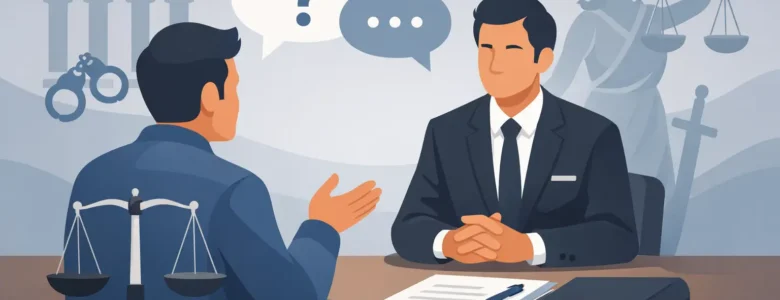
An arrest, a police investigation, or a court notice can put your life on hold fast. The questions to ask a criminal defense lawyer should help you determine whether that attorney is prepared to protect your rights, challenge the government’s case, and act quickly when the stakes are high.
You do not need to understand every criminal statute before a consultation. You do need clear answers about who will handle your case, what risks you face, and what the attorney plans to do next. A strong defense begins with direct communication and a lawyer who is ready to fight, not simply move your case through the system.
Criminal charges can carry very different consequences depending on the allegations, the court, your record, and the evidence involved. Ask whether the attorney has handled cases involving your specific charge, whether it is DUI, drug possession, assault, theft, a weapons allegation, domestic violence, fraud, or a felony offense.
Experience should be specific, not vague. A lawyer who has worked on criminal cases for years may still have limited experience with the type of charge or court involved in your case. Ask what issues commonly arise in similar matters and how local practices may affect the process. Georgia criminal cases can move differently from one county to another, and local courtroom knowledge can matter.
You deserve to know who will appear with you in court, answer your calls, review the evidence, and negotiate with the prosecutor. Some firms rely heavily on junior attorneys or support staff after the initial consultation. That structure is not necessarily wrong, but you should understand it before you sign an agreement.
Ask who your primary contact will be and whether the lawyer you meet will be the lawyer making strategic decisions. If more than one attorney may work on the case, ask how responsibilities will be divided. Clear expectations early can prevent frustration when you need an answer quickly.
A credible criminal defense lawyer should not promise a dismissal or an acquittal before reviewing the facts. No attorney can ethically guarantee a result. But an experienced lawyer should be able to identify initial concerns after hearing your account and reviewing available documents.
Ask what evidence the prosecution may rely on, such as officer testimony, video, lab testing, witness statements, digital records, or an alleged confession. Then ask what may be challenged. The issue could be an unlawful stop, an improper search, unreliable identification, a gap in the chain of custody, inconsistent witnesses, or weak proof of intent.
The answer may be, “It depends on the discovery.” That can be an honest answer. What matters is whether the attorney explains what information is missing and how they intend to obtain and evaluate it.
Early action can make a real difference. Evidence can disappear, surveillance footage can be overwritten, and witnesses’ memories can fade. If you are under investigation but have not been charged, speaking to law enforcement without counsel can create serious problems.
Ask the attorney what you should and should not do immediately. Depending on the circumstances, that may include preserving text messages, identifying witnesses, avoiding contact with an alleged victim, complying with bond conditions, or preparing for a first court appearance. If you have an upcoming hearing, ask exactly what it is for and whether your attendance is required.
A lawyer should also explain whether there are deadlines for filing motions, requesting evidence, or challenging certain procedures. A defense strategy cannot wait until the eve of trial.
Most criminal cases do not reach a jury trial, often because charges are dismissed, evidence changes, or a negotiated outcome makes sense. Still, trial experience matters long before a jury is selected. Prosecutors know which attorneys are prepared to litigate difficult issues and take a case all the way when necessary.
Ask about the lawyer’s courtroom background and trial experience. You are not looking for dramatic promises. You are looking for an attorney who can investigate the facts, cross-examine witnesses, argue motions, select a jury, and present a defense when negotiation is not enough.
The right strategy depends on the evidence and your goals. A lawyer should be able to discuss both paths: seeking a favorable resolution where appropriate and preparing aggressively for trial if the state cannot prove its case.
This question is different from asking for a guarantee. Ask the lawyer to explain the range of possible outcomes, including dismissal, reduction of charges, diversion, probation, a negotiated plea, trial, or sentencing exposure if there is a conviction.
For some first-time offenses, alternatives may be available. For other charges, prior convictions, mandatory minimums, probation status, or aggravating allegations can sharply limit the options. A lawyer who gives you a realistic assessment is doing you a service, even when the news is difficult.
Ask what factors could improve or worsen your position. Completing an evaluation, staying out of further trouble, maintaining employment, or complying with bond conditions may matter in some cases. Your attorney should tell you what steps are useful and what actions could damage the defense.
The prosecution has the burden of proof, but a serious defense requires independent work. Ask whether the attorney will obtain police reports, body-camera footage, 911 calls, medical records, forensic results, photographs, and other discovery. Ask whether witnesses will be interviewed and whether an investigator or expert may be needed.
Not every case requires an expert witness or a large investigation budget. The decision should be based on the facts. In a DUI case, for example, the reliability of testing and the legality of the traffic stop may be central. In an assault case, witness credibility, injuries, self-defense, and video evidence may require close examination.
A lawyer should be able to explain what evidence could change the direction of the case and how they will pursue it.
A criminal case can affect far more than a court sentence. Ask about consequences for your driver’s license, employment, professional license, college enrollment, housing, child custody, firearm rights, immigration status, and reputation.
This question is especially urgent for noncitizens. Even a plea that seems minor can create severe immigration consequences. Tell the lawyer about your citizenship or immigration status at the beginning of the consultation, not after you have accepted an agreement. If your case overlaps with family law, business concerns, or another legal issue, ask whether the firm can help coordinate a broader legal response.
Criminal cases are stressful partly because clients often wait weeks between hearings with little information. Ask how the firm handles updates, how quickly calls are typically returned, and whether you can contact someone after hours if an emergency arises.
You should also ask what information the attorney needs from you. A good defense depends on honesty. Share the details that feel damaging or embarrassing. Surprises are dangerous in court, but confidential communication allows your lawyer to prepare for them.
Ask for a clear explanation of the fee arrangement. Find out whether the fee is flat, hourly, or structured in stages, and whether it covers pretrial work, motions, hearings, trial preparation, and a jury trial. Also ask about potential expenses for investigators, experts, records, transcripts, or other case-related costs.
The lowest fee is not always the best value if it buys little more than a plea appearance. At the same time, a higher fee alone does not prove quality. Look for straightforward terms, a clear scope of work, and an attorney who explains what the firm will do to defend you.
Bring or save every document connected to the case, including citations, bond paperwork, court notices, police paperwork, photos, videos, and messages. Write down the names of possible witnesses and a timeline of what happened while your memory is fresh. Do not alter messages, delete posts, or try to contact witnesses or an alleged victim to “clear things up.” Those choices can create new problems.
Most of all, be candid. The lawyer’s job is to protect you, but effective and aggressive representation depends on knowing the full picture. The facts you share privately allow counsel to test the prosecution’s evidence and prepare for what may come next.
When your freedom, record, career, or family is at risk, do not settle for vague reassurances. Ask direct questions, expect direct answers, and choose counsel prepared to stand beside you in court. Cuadra & Patel, LLC provides the focused, trial-ready advocacy Georgia defendants need when the consequences are serious.
contact us 24/7
(404) 373-6336
contact us via email