
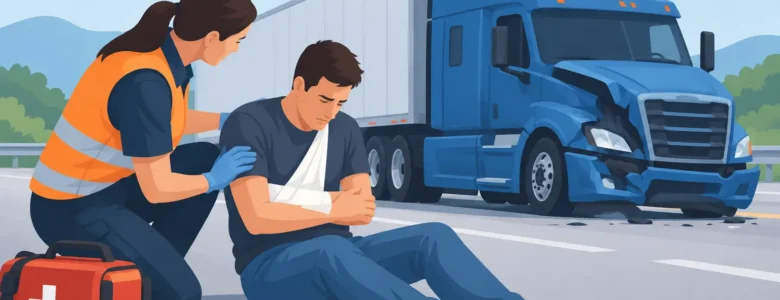
A collision with a commercial truck is rarely a minor event. The difference in size and force between an 80,000-pound tractor-trailer and a passenger vehicle can leave people facing painful, expensive, and life-changing harm. Common truck accident injuries are not always obvious at the crash scene, either. Adrenaline can hide serious symptoms for hours or days, while insurance companies may begin building their defense immediately.
Getting medical attention is the first priority. Protecting your ability to recover financially matters, too. A prompt evaluation creates a record of what happened to your body, connects the injury to the crash, and gives doctors a chance to identify conditions that can worsen without treatment.
Truck accidents involve forces that ordinary passenger-car crashes do not. A loaded commercial vehicle needs far more distance to stop, has a higher point of impact, and can crush, underride, or force a smaller vehicle into another object. Rollovers, jackknifes, wide turns, and cargo spills can create additional hazards after the initial impact.
Severity depends on the speed, angle of collision, use of seat belts, airbag deployment, and whether a person was walking, riding a motorcycle, or inside a smaller vehicle. Age and prior health conditions can also affect recovery. But a preexisting condition does not give an insurance company a free pass to blame all of a victim’s pain on the past. A crash can aggravate an existing injury, and that aggravation deserves careful medical and legal attention.
A traumatic brain injury can happen when the head strikes a window, steering wheel, airbag, or headrest. It can also result from the violent back-and-forth movement of the brain inside the skull, even when there is no direct blow to the head.
Symptoms may include headaches, dizziness, nausea, confusion, ringing in the ears, sensitivity to light, memory problems, mood changes, or trouble concentrating. A person who seems alert after a crash may still have a concussion or a more serious brain injury. Emergency care is especially urgent after loss of consciousness, repeated vomiting, worsening headache, seizures, unequal pupils, weakness, or unusual behavior.
Brain injuries can affect work performance, family relationships, and the ability to manage daily tasks. Those losses are real even when a CT scan does not immediately show the full extent of the injury.
Whiplash is frequently dismissed as a minor injury, but neck trauma can lead to persistent pain, limited movement, headaches, nerve symptoms, and sleep disruption. Truck collisions can also cause herniated discs, fractured vertebrae, spinal stenosis, and damage to muscles and ligaments.
The most devastating spinal injuries involve the spinal cord. Depending on the location and severity, a victim may experience numbness, weakness, loss of coordination, paralysis, or loss of bladder and bowel control. These injuries often require emergency treatment, surgery, rehabilitation, assistive devices, home modifications, and long-term care.
Back pain after a crash should not be ignored simply because it starts as stiffness. Tell the treating provider exactly where the pain is located, whether it radiates into an arm or leg, and whether you feel tingling, numbness, or weakness.
Fractures are common when a smaller vehicle absorbs the force of a truck impact. Victims may suffer broken ribs, arms, legs, hips, ankles, wrists, or facial bones. Some fractures heal with a cast or brace; others require plates, screws, rods, or multiple surgeries.
Joint injuries can be equally disruptive. Damage to a shoulder, knee, hip, or wrist may limit mobility and prevent someone from returning to a physical job. Even after a bone heals, chronic pain, reduced range of motion, arthritis, and the need for future treatment may remain.
Seat belts save lives, but the force of a crash can still cause internal trauma. Internal bleeding, collapsed lungs, bruised lungs, damaged kidneys, spleen injuries, and liver injuries may not be visible from the outside. Abdominal pain, chest pain, shortness of breath, fainting, pale skin, or increasing weakness after a collision requires immediate medical evaluation.
These conditions can become dangerous quickly. Do not assume you are safe because you were able to walk away from the wreck or because the vehicle damage appears limited.
Truck crashes may involve fuel fires, hazardous cargo, shattered glass, exposed metal, and airbag-related burns. Deep cuts can damage nerves, tendons, and muscles. Burns may require skin grafts, infection treatment, reconstructive procedures, and extended recovery.
Scarring and disfigurement carry more than physical consequences. They can change a person’s confidence, emotional health, employment options, and social life. Photographs, treatment records, and specialist evaluations can be important in documenting the full impact.
The emotional effects of a violent truck crash deserve the same serious attention as physical injuries. Anxiety, depression, panic attacks, nightmares, insomnia, and post-traumatic stress can make it difficult to drive, work, or participate in normal family life.
Some people feel emotionally shaken only after the immediate crisis has passed. Seeking counseling or mental health care is not a sign of weakness. It is part of treating the harm caused by the collision.
Delayed symptoms are common after truck accidents. Pain may become noticeable after swelling and adrenaline wear off, while some brain and soft-tissue injuries develop gradually. Follow up with a doctor promptly rather than trying to push through new or worsening symptoms.
Be accurate and consistent when describing how the crash happened and how your injuries affect you. Keep copies of discharge instructions, prescriptions, imaging results, therapy recommendations, medical bills, and records of missed work. A simple daily note about pain levels, limitations, sleep problems, and activities you cannot perform can also show how the injury changes your life over time.
Avoid giving a recorded statement or accepting a quick settlement before you understand your diagnosis and treatment plan. The trucking company’s insurer may contact you early, often before you know whether surgery, rehabilitation, or future care will be necessary. Early money can be tempting when bills are arriving, but a settlement generally ends the right to seek additional compensation later.
Truck injury claims often involve more evidence than a typical car wreck. The driver may have electronic driving logs, inspection reports, training records, dispatch communications, dash-camera footage, and data from the truck’s electronic control module. The carrier may also have maintenance records and cargo information.
That evidence may help answer critical questions: Was the driver fatigued? Was the truck speeding? Was it properly maintained? Was the load secure? Did the company ignore a safety problem? The answer depends on the facts, and preserving records early can make a meaningful difference.
A skilled attorney can investigate the crash, identify all responsible parties, calculate present and future losses, and prepare the case for litigation if the insurer refuses to act fairly. Cuadra & Patel, LLC represents injured people across Georgia with the focused, aggressive advocacy serious truck accident cases demand.
Recovery after a truck crash is rarely linear. One appointment can lead to physical therapy, specialist care, surgery, or time away from work. Give yourself permission to take symptoms seriously and follow your medical providers’ guidance.
If a truck collision has left you injured or uncertain about what comes next, speak with an experienced personal injury attorney as soon as possible. The right action now can preserve evidence, protect your claim, and give you room to focus on healing.
contact us 24/7
(404) 373-6336
contact us via email