
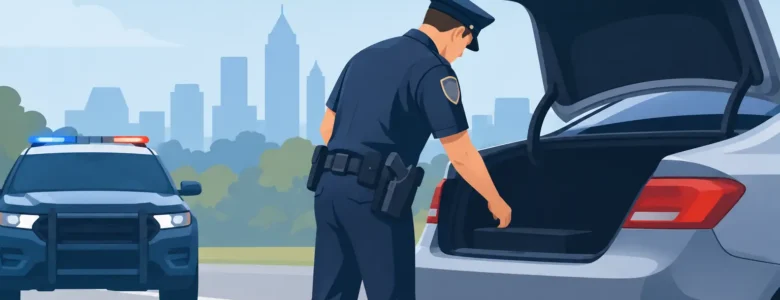
A traffic stop can turn tense in seconds. An officer asks, “Do you mind if I look inside your car?” You may be wondering, can police search my car simply because you were pulled over? In Georgia, the answer is usually no – not without a warrant, your valid consent, or a recognized exception to the warrant requirement.
That distinction matters. A lawful traffic stop does not automatically give law enforcement unlimited authority to search your vehicle, your trunk, your backpack, or your phone. But vehicle-search law has exceptions, and the facts of the stop can change the analysis quickly. What you say, where an item is located, whether someone is arrested, and what an officer claims to observe may all affect the outcome.
Police may stop a vehicle when they have reasonable suspicion that a traffic law or criminal law has been violated. A broken taillight, speeding allegation, expired registration, improper lane change, or suspected DUI can provide a basis for a stop.
Once the vehicle is stopped, the officer may generally ask for your license, registration, and proof of insurance. They may also ask questions related to the reason for the stop and run warrant or license checks. But the stop cannot be prolonged beyond the time reasonably needed to handle its original purpose unless the officer develops independent reasonable suspicion of other criminal activity or you voluntarily agree to continue the encounter.
A request to search is not the same as legal authority to search. Officers can ask. You are generally not required to agree.
If you do not want to consent, keep your response calm and clear: “I do not consent to a search.” Do not argue, physically resist, hide items, or interfere with the officer. A refusal to consent does not give an officer permission to search, although it also does not prevent a search if another legal exception applies.
The Fourth Amendment protects people from unreasonable searches and seizures. Ordinarily, police need a warrant to conduct a search. Cars are treated differently in some situations because they are mobile and because drivers have a reduced expectation of privacy in a vehicle compared with a home.
That does not mean every warrantless search is lawful. It means prosecutors may rely on one of several exceptions. The most common are consent, probable cause, a search connected to an arrest, plain view, and an inventory search after a lawful impoundment.
Consent is one of the most frequent reasons officers give for a vehicle search. If you voluntarily agree, police may search within the scope of what you permitted. A vague “yes” can be interpreted broadly. Consent can sometimes be withdrawn, but doing so may not undo a search already completed or stop officers who have developed another lawful reason to continue.
The issue is not always as simple as whether a driver said yes. Courts may consider whether consent was truly voluntary, whether the person had authority over the vehicle, whether there was pressure or coercion, and whether language barriers or confusing instructions affected the encounter.
A passenger may have privacy rights in personal belongings, even when the driver controls the car. A person who owns or regularly uses the vehicle may also have standing to challenge an unlawful search. These questions are highly fact-specific.
If officers have probable cause to believe a vehicle contains evidence of a crime or contraband, they may be able to search it without first obtaining a warrant. This is often called the automobile exception.
Probable cause requires more than a hunch. Officers may point to observations such as visible contraband, statements by an occupant, the smell of drugs, or credible information connecting the car to criminal activity. If probable cause exists, the permitted scope can extend to areas of the vehicle where the item sought could reasonably be found. Depending on the circumstances, that can include the passenger compartment, trunk, and closed containers.
The claimed smell of marijuana is a recurring issue in Georgia vehicle cases. Hemp and marijuana can look and smell alike, and the legal analysis can depend on the officer’s observations, training, other evidence, and the timing of the incident. Do not assume an officer’s statement ends the matter. A defense attorney can examine whether the claimed probable cause was legally sufficient.
An arrest does not automatically authorize officers to search every part of a vehicle. After an occupant’s arrest, police may search the passenger compartment in limited situations, such as when the arrested person could access the car at the time of the search or when officers reasonably believe evidence related to the offense of arrest may be inside.
For example, an arrest based on an outstanding warrant does not necessarily create the same basis to search a car as an arrest involving suspected drug possession. The reason for the arrest and the timing of the search matter.
Police may seize evidence that is plainly visible from a lawful position when its incriminating nature is immediately apparent. If an officer lawfully looks through a window and sees what appears to be illegal drugs or a weapon, that observation may provide grounds for further action.
Plain view is not a free pass to rummage through the car. The officer must have a lawful right to be where they are and cannot create the view through an unlawful search.
If a vehicle is lawfully impounded, police may conduct an inventory of its contents under standardized procedures. The stated purpose is generally to protect property, protect officers from claims of theft or damage, and identify dangerous items.
However, an inventory search cannot be used as a pretext for an investigative search. Whether the impoundment was justified and whether the agency followed its own policy can become critical issues in a criminal case.
Your conduct during a stop can protect your safety and preserve your legal options. Pull over safely, keep your hands visible, provide required documents, and avoid sudden movements. You do not need to volunteer information about where you are going or what is in the vehicle beyond what the law requires.
If asked for consent, a direct and respectful refusal is enough. Ask whether you are free to leave. If you are detained or arrested, do not make statements designed to explain away evidence or persuade the officer. Exercise your right to remain silent and ask for a lawyer.
Do not consent just because you believe you have “nothing to hide.” A search can reveal another person’s belongings, a forgotten item, prescription medication without its original container, or information officers interpret incorrectly. More importantly, consent can make it much harder to challenge the search later.
If officers search anyway, do not physically resist. Take mental notes when you can: the time and location, what officers said, whether they asked for consent, who was present, what was searched, and whether the vehicle was towed. Preserve any dashcam footage, passenger communications, receipts, or other evidence that may establish the timeline.
When police violate constitutional search-and-seizure rules, evidence obtained from that violation may be challenged through a motion to suppress. If a court suppresses drugs, weapons, statements, or other evidence, the prosecution’s case may be weakened substantially. In some cases, charges cannot move forward.
But suppression is never automatic. The state may argue that consent was valid, probable cause existed, the evidence would have been discovered lawfully, or an officer acted in good-faith reliance on a warrant. Strong criminal defense requires a close review of body-camera video, dispatch records, police reports, towing policies, witness accounts, and the precise sequence of events.
The first version of events in a police report is not the final word. Details often decide whether a search was constitutional.
If you were arrested after a vehicle search in metro Atlanta or elsewhere in Georgia, act quickly before evidence disappears and memories fade. Cuadra & Patel, LLC provides experienced, aggressive representation for people facing serious criminal allegations. The strongest next step is a careful legal review while the facts can still be challenged.
contact us 24/7
(404) 373-6336
contact us via email