
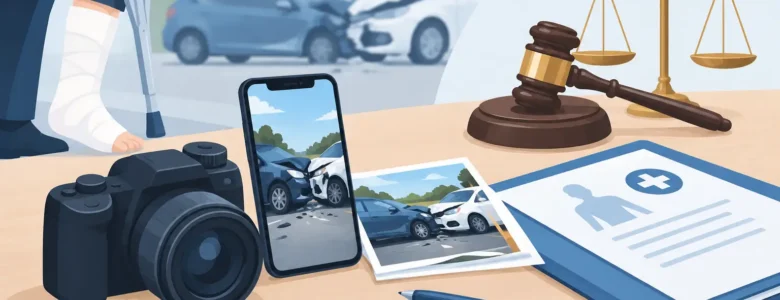
A crash scene is cleared quickly. A dangerous spill is mopped up. Witnesses go home and memories fade. That is why the best evidence for a personal injury claim is often the evidence secured in the first hours and days after an accident. If another person or business caused your injuries, strong proof can protect your right to seek the compensation you need for medical care, lost income, and the harm the accident has caused.
Insurance companies do not pay claims based on sympathy. They examine the facts, look for gaps, and challenge injuries whenever they can. A well-prepared case answers the hard questions before the other side can use them against you: What happened? Who was responsible? How badly were you hurt? How has the injury changed your daily life?
Every injury case turns on proof. In practical terms, the evidence needs to show that another party had a duty to act safely, failed to meet that duty, and caused your injury. It must also establish the full value of your losses.
A driver who runs a red light, a property owner who ignores a known hazard, or a company that allows unsafe conditions may be responsible. But responsibility alone is not enough. You also need credible evidence connecting that conduct to your physical injuries, treatment, financial losses, and pain.
The strongest claims do not rely on one document or one person’s version of events. They build a consistent record from several sources. A police report may support photos from the scene. Medical records may support your testimony about pain and work restrictions. Video footage may confirm what a witness saw. When the proof fits together, it is much harder for an insurer to minimize the claim.
Visual evidence can be powerful because it preserves conditions that may disappear almost immediately. After a vehicle collision, take photos and video of vehicle damage, skid marks, debris, traffic lights or signs, the road surface, weather, and visible injuries. In a fall or premises liability case, capture the spill, broken step, poor lighting, uneven surface, lack of warning signs, and the wider area around the hazard.
Take more than one angle. Close-up images show details, while wider images establish location and context. Do not edit the original files. Keep them saved with the date and time information intact.
Not every accident victim is physically able to gather evidence. Get medical help first. If you can, ask a family member, friend, or another trusted person to document the scene for you.
For a car wreck, law enforcement officers may prepare a report identifying the parties, recording statements, listing apparent traffic violations, and documenting basic scene details. The report is not always the final word on fault, but it can be a valuable starting point for an investigation.
If you are hurt at a business, apartment complex, workplace, or other property, report the incident promptly and request that an incident report be made. Give accurate facts without guessing or downplaying your injuries. Ask how to obtain a copy, and write down the name and position of the person who received your report.
A missing report does not automatically defeat a case. It can, however, give the other side room to argue that the incident was never reported or happened differently. Prompt documentation closes that opening.
Independent witnesses are especially valuable. Unlike the injured person and the at-fault party, they often have no direct financial stake in the outcome. A witness may have seen a driver texting, watched someone ignore a warning, or observed the dangerous condition before the accident occurred.
Get names, phone numbers, email addresses, and brief notes about what each person saw. Do not assume the police report contains every witness or every detail. A lawyer can later obtain a detailed statement, but that effort is far more effective when the witness can still be located.
Medical evidence is central to nearly every personal injury claim. Seek appropriate medical care as soon as possible, even if adrenaline initially masks pain. Delays in treatment can allow an insurer to claim that your injury was minor, unrelated, or caused by something else.
Your medical record should document your symptoms, diagnosis, treatment plan, prescriptions, imaging, referrals, restrictions, and prognosis. Follow through with recommended care when you can. If a treatment plan is too expensive, unavailable, or causes problems, tell your provider and document the reason rather than simply stopping treatment.
Be honest about prior injuries or medical conditions. A prior condition does not give another party permission to make you worse. But hiding your history can damage credibility when the insurer finds earlier records. The real issue is whether the accident caused a new injury or aggravated an existing one.
A serious injury can affect far more than your medical bills. Wage statements, tax records, employer letters, schedules, and disability paperwork can show missed work and reduced earning capacity. Keep records of every expense tied to the injury, including medications, mileage to appointments, medical equipment, parking, household help, and repair or replacement costs.
If you are self-employed, the proof may require more detail. Invoices, contracts, canceled jobs, profit-and-loss statements, and communications with clients can help establish income lost because you could not perform your work.
Many cases are decided by evidence that would have vanished without quick action. Nearby businesses, homes, traffic cameras, dashcams, rideshare vehicles, and doorbell cameras may have recorded the event. Some systems automatically erase footage within days or weeks.
Electronic evidence can also include phone records, vehicle data, text messages, dispatch logs, maintenance records, or data from commercial trucks. Damaged clothing, a defective product, and the vehicle involved in a collision may be physical evidence as well. Do not repair, discard, or alter key items until you understand whether they need to be preserved.
An experienced injury attorney can send preservation notices to put responsible parties on notice that evidence must not be destroyed. Speed matters. Once footage is overwritten or a vehicle is repaired, a critical piece of proof may be gone for good.
Medical charts explain diagnoses, but they do not always show what life feels like after an injury. A simple daily journal can provide valuable context. Record pain levels, missed events, sleep problems, mobility limits, medication effects, and tasks you can no longer do without help.
This is not about exaggeration. It is about making a truthful record while details are fresh. Your own account, supported by testimony from family members, coworkers, or friends, can show how an injury disrupted your work, independence, and relationships.
Use social media with caution while a claim is pending. A single photo or post can be taken out of context and used to argue that you are less injured than you claim. The safest approach is to avoid posting about the accident, your recovery, or physical activities until you have received legal guidance.
People often assume the insurer will gather the evidence fairly. That assumption can be costly. The insurer’s job is to protect its financial interests, not to build the strongest case for you.
Avoid giving a recorded statement or accepting a quick settlement before you know the nature and extent of your injuries. Early offers frequently arrive before treatment is complete and before future medical needs are clear. Also avoid posting blame, apologizing, speculating about fault, or saying you are “fine” when you are injured and still being evaluated.
Keep a single file for records, photographs, receipts, claim correspondence, and notes about every conversation. Organization does not replace legal representation, but it gives your attorney a stronger foundation from the start.
Legal help is particularly valuable when fault is disputed, injuries are serious, multiple parties may be involved, or an insurer is pressuring you to settle. A lawyer can investigate the accident, preserve evidence, identify all available insurance coverage, calculate losses, and prepare the case for trial if a fair resolution is not offered.
Cuadra & Patel, LLC provides effective and aggressive representation for injured people across Georgia. A claim should be evaluated on its facts, not on an insurer’s first assessment or a quick settlement number.
The next step is simple: protect your health, preserve what you can, and get experienced legal guidance before critical evidence disappears. The facts of your case deserve to be heard with the full force of the proof behind them.
contact us 24/7
(404) 373-6336
contact us via email